
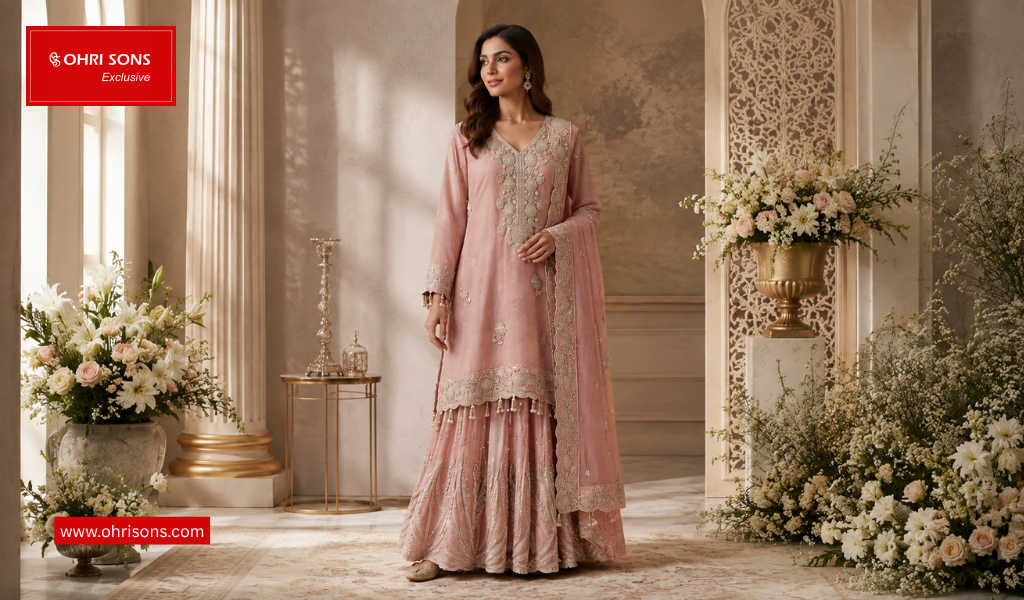
There’s a specific kind of outfit anxiety that hits right before wedding season starts, you know you need something festive, but a lehenga feels like too much work and a plain suit feels like too little. A sharara usually ends up being the answer. It has movement, it has drama when you need it, and you can actually sit down in one without recalculating your life choices. That said, shopping for designer sharara suits online isn’t always straightforward. Fabric names get thrown around loosely, “designer” gets stretched to mean almost anything, and half the product photos don’t tell you how the piece will actually feel three hours into a sangeet. So here’s a more grounded walkthrough of what to actually look for.
Sharara, Gharara, or Palazzo — They’re Not the Same Thing
People use these three names interchangeably, which honestly causes most of the confusion. A gharara has an actual seam at the knee, it’s stitched as two separate flared pieces joined together, so you get a distinct break in the silhouette. A sharara, on the other hand, flares out more gradually from somewhere near the hip or thigh, so the movement looks softer and less segmented. A palazzo suit doesn’t flare dramatically at all, it’s closer to a wide-leg pant. If you’ve ever bought a “sharara” online and felt like it didn’t move the way you expected, there’s a decent chance it was cut closer to a palazzo.
Picking Fabric Based on What You’re Actually Doing That Day
This is where most people get it wrong, mostly because they’re shopping from a laptop and not thinking about standing in Delhi heat for four hours at a mehendi.
Daytime, outdoor functions, mehendi, haldi, genuinely call for something lighter. Cotton suits for women or a chanderi weave breathe better and won’t leave you sweating through the dupatta by noon. Chanderi in particular has this natural sheen that photographs nicely without weighing you down.
Evening functions, sangeets, dinners, this is georgette territory. It’s the fabric that shows up most often in sharara collections for a reason: it drapes without stiffening, it moves when you dance, and it can carry a decent amount of embroidery without looking overloaded.
The actual wedding day, or a big Diwali evening, is when velvet earns its place. It photographs beautifully indoors, under warm lighting, and it has a weight to it that reads as “occasion wear” the second you walk in. Some people also go for hand painted suits online for pre-wedding shoots or smaller intimate functions, less common, but the kind of thing that photographs like nothing else on the rack.
What the Embroidery Is Actually Telling You
Zari, the metallic gold or silver thread, is the most traditional route, and it’s usually what people mean when they picture a “wedding-ready” sharara. Mirror work leans more festive and a bit folk-inspired, which is why you see it a lot around Navratri. Sequins and stone work are for maximum shine, receptions, cocktail nights, that kind of thing. And then there’s plain thread embroidery, which is quieter and, honestly, the most rewearable, you’re not going to feel overdressed wearing it to a smaller family function later.
If you’re only buying one or two shararas for an entire wedding season, thread work or light zari is the safer bet. It won’t scream “I wore this to exactly one event.”
Getting the Fit Right (Because This Is Where It Falls Apart)
A sharara suit lives or dies on fit in a way a saree doesn’t. The kurti should generally hit somewhere between mid-thigh and just above the knee, go shorter and the proportions start looking off against a flared bottom. The flare itself matters more than people think: starting it from the waist tends to suit most body types, while a flare that kicks in closer to the knee can look better on someone petite, since it doesn’t overwhelm a smaller frame.
If you already know your measurements well, buying unstitched and getting it tailored locally almost always gives a cleaner drape than a standard size off the rack, worth the extra step if the event matters.
Color: Wedding Guest vs. Festive Occasion
For someone else’s wedding, jewel tones, emerald, wine, a deep royal blue, tend to photograph better than pastels under typical Indian wedding lighting, and they don’t compete with whatever the bride is wearing. For festive occasions like Diwali or Karva Chauth, gold, maroon, and mustard are the reliable choices, though Navratri obviously runs on its own color-of-the-day system. Daytime functions are really the only place pastels genuinely work well, since the lighting is softer and the mood is more casual to begin with.
How It Compares to Other Options
If you’re torn between a sharara and, say, party wear suits online in a different silhouette, a sharara generally gives you more drama and movement than a palazzo set, without the weight and structure of a full lehenga. It’s a fair middle ground. Pakistani suits online often share a similar base silhouette but tend to run with longer kurtas and finer embroidery detailing, so that’s worth a look if you want something that reads slightly different from the typical Indian bridal-market sharara.
Spending Across a Wedding Season
Rather than spending the same amount on every function, it’s usually smarter to tier it: cotton or chanderi for daytime events since they’re the cheapest, georgette with moderate work for sangeets and parties, and velvet or heavier silk-blend pieces with real zari or stonework reserved for the wedding day itself — those are the ones you’ll actually rewear for future weddings anyway, so the higher price tag holds up over time.
A Little Bit of Care Goes a Long Way
Anything with real zari or stone work should go to a dry cleaner rather than the washing machine, home washing loosens the threadwork faster than most people expect. Store the kurti and the sharara bottom separately, folded in muslin rather than plastic, so nothing snags. And when it needs freshening up before the next event, steam it instead of ironing directly over the embellished parts.
The Short Version
A sharara earns its place in a wedding wardrobe because it does more than most outfits manage, comfortable enough to survive a whole night of dancing, dressed-up enough for the main event, and if you pick the fabric and embroidery with a bit of thought, versatile enough to wear again. It’s less about finding the “perfect” one and more about matching the outfit to what the day actually demands of you.
FAQ’s
1. What is the difference between a sharara and a gharara suit?
2. Which fabric works best for a sharara suit at a sangeet?
3. Can I wear a sharara suit for a daytime function like mehendi?
4. How do I know which sharara flare suits my body type?
5. Should I buy a stitched or unstitched sharara suit online?