
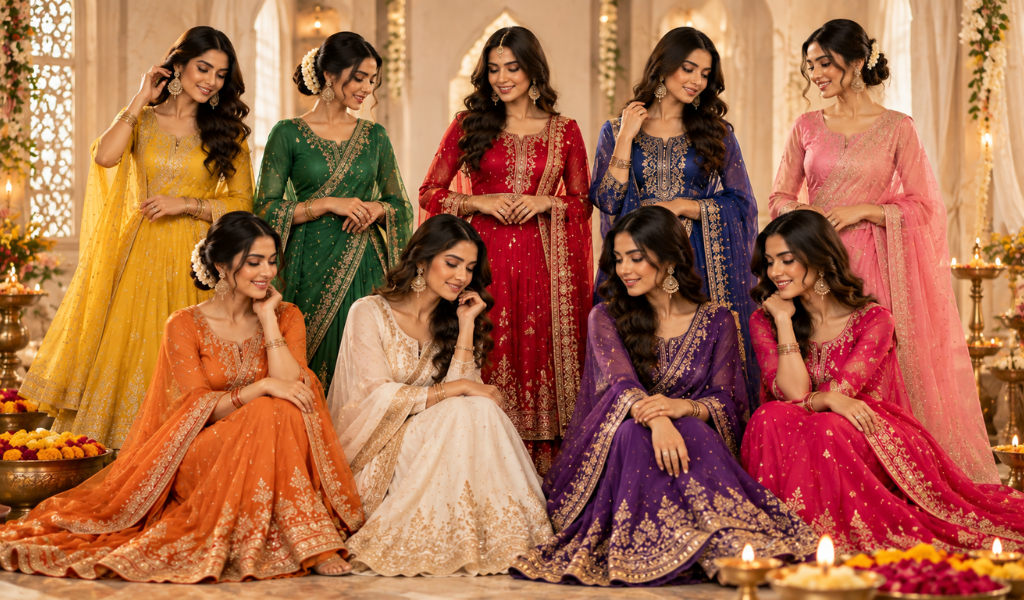
Every year, a day or two before Navratri, the same message lands in the family WhatsApp group: “Kal ka colour kya hai?” Someone replies with a chart, someone else says the chart is wrong, and by then half the family has already ironed the wrong dupatta.
To save you that scramble, here is the correct 2026 list. Sharad Navratri begins on Sunday, 11 October, and runs until Monday, 19 October, with Vijayadashami (Dussehra) on Tuesday, 20 October. Below you’ll find the colour for each day, the form of Maa Durga worshipped, and simple saree and suit ideas so you can plan all nine looks in one go.
Quick answer: Navratri 2026 colours in order
- Day 1 (11 Oct): Orange
- Day 2 (12 Oct): White
- Day 3 (13 Oct): Red
- Day 4 (14 Oct): Royal blue
- Day 5 (15 Oct): Yellow
- Day 6 (16 Oct): Green
- Day 7 (17 Oct): Grey
- Day 8 (18 Oct): Purple
- Day 9 (19 Oct): Peacock green
The 9 Colours Tradition Explained
Navratri is nine nights of worship dedicated to the nine forms of Maa Durga, known together as the Navadurga. Wearing a different colour each day is a much-loved custom that has grown stronger over the years, especially across North and West India. Each shade is linked to a mood or quality: orange for warmth and energy, white for calm and simplicity, red for strength, and so on.
Two things are worth knowing before you shop:
- The order changes every year. The colour of Day 1 follows the weekday on which Navratri begins. In 2026 it starts on a Sunday, and Sunday’s colour is orange, so the rest of the cycle follows from there. A chart from last year (or the year before) will not match, so avoid reusing an old screenshot.
- It is a tradition, not a rule. Nobody is checking your dupatta. If you don’t own something in the colour of the day, red and yellow are always safe choices, and devotion matters far more than an exact shade match.
One more practical note: the puja itself follows the lunar tithi, and a few local panchangs can shift a day by one date. If your family follows a specific temple or pandit’s calendar, go with that for the puja, and use the colours below as your outfit guide.
Day-Wise Colour & Outfit Guide (Day 1 to Day 9)
| Day | Date | Devi form | Colour |
|---|---|---|---|
| 1 | Sun, 11 Oct | Maa Shailputri | Orange |
| 2 | Mon, 12 Oct | Maa Brahmacharini | White |
| 3 | Tue, 13 Oct | Maa Chandraghanta | Red |
| 4 | Wed, 14 Oct | Maa Kushmanda | Royal blue |
| 5 | Thu, 15 Oct | Maa Skandamata | Yellow |
| 6 | Fri, 16 Oct | Maa Katyayani | Green |
| 7 | Sat, 17 Oct | Maa Kalaratri | Grey |
| 8 | Sun, 18 Oct | Maa Mahagauri | Purple |
| 9 | Mon, 19 Oct | Maa Siddhidatri | Peacock green |
Mid-October in and around Delhi NCR is still warm in the afternoon and pleasant by evening, so lighter fabrics like cotton, chanderi and georgette make the most sense for the daytime pujas. Our Fabric Guide explains which fabric works when, if you’re unsure.
Day 1: Orange for Maa Shailputri
Ghatasthapana day, and usually the busiest morning of the nine. Choose something you can move in easily.
- Saree: An orange cotton silk or e with a slim gold border
- Suit: A straight-cut orange chanderi suit with a cream or off-white dupatta
- If orange isn’t your shade, mustard or marigold tones look lovely on most skin tones
Day 2: White for Maa Brahmacharini
White is calm and simple, and it works well for fasting days.
- Saree: A white or off-white cotton saree with a soft pastel border
- Suit: A white cotton or muslin suit paired with a coloured dupatta so it doesn’t look flat
- Keep the kumkum plate at arm’s length. White forgives nothing.
Day 3: Red for Maa Chandraghanta
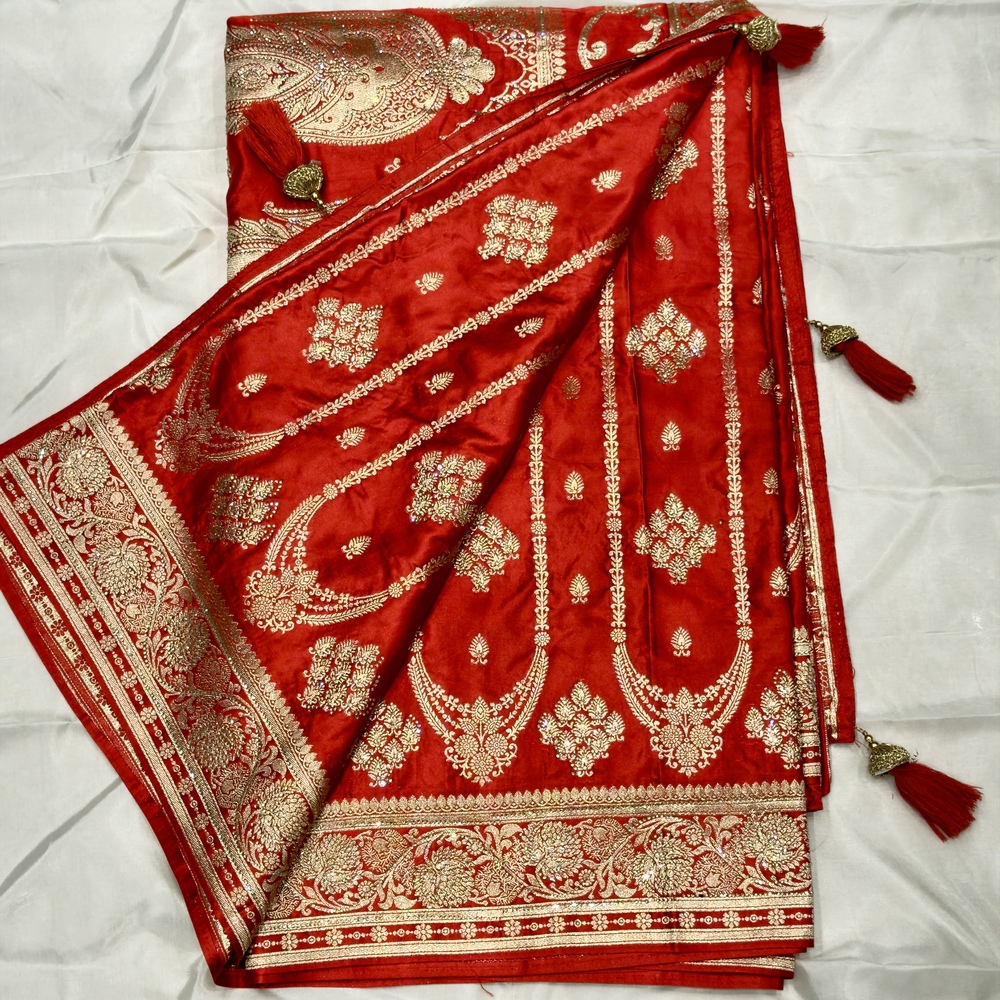
Red is already auspicious in most homes, so this is the easiest day to dress for.
- Saree: A red Banarasi or georgette saree with zari work for the evening aarti
- Suit: A red Anarkali or straight-cut suit with gold jewellery
- Red also photographs beautifully in diya light
Day 4: Royal Blue for Maa Kushmanda
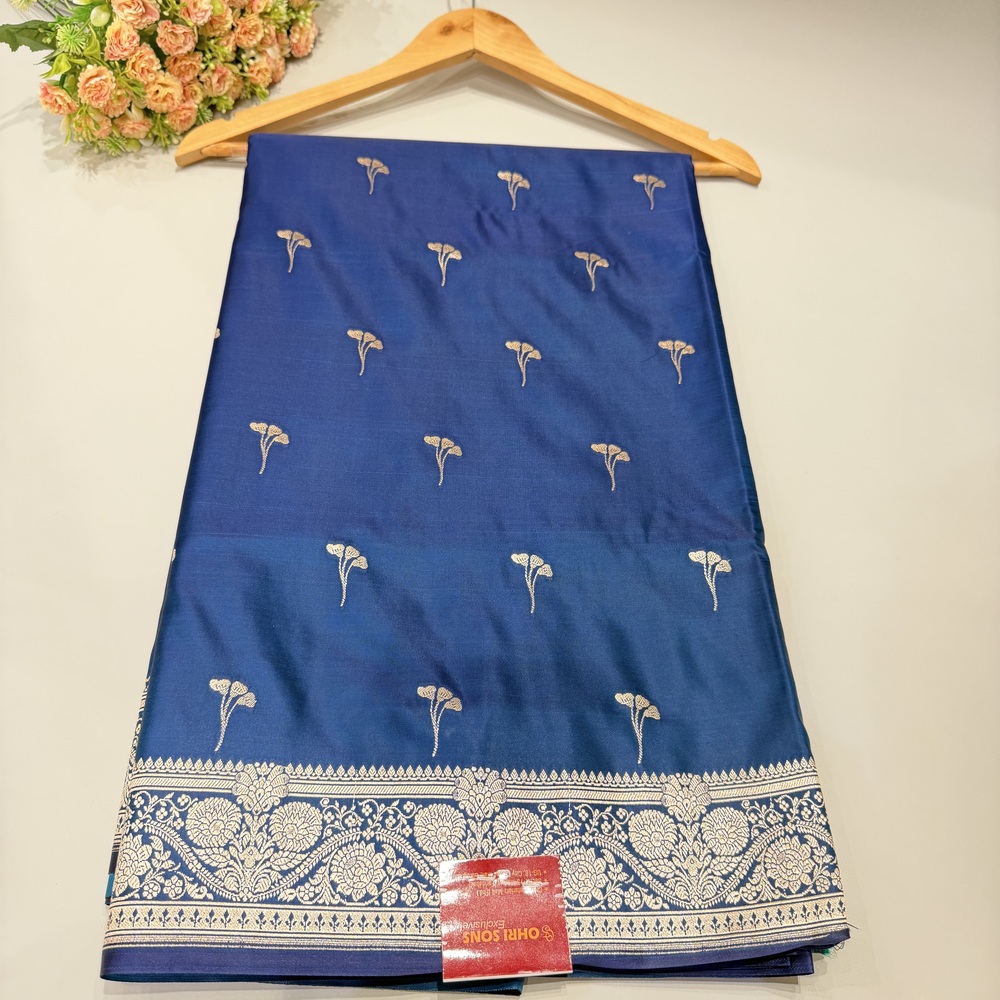
Royal blue sits between festive and formal, so it suits a working day too.
- Saree: A royal blue organza or georgette saree, lightweight and easy to drape
- Suit: A blue silk-blend or georgette suit with silver or gold accessories
- Blue works with both metals, which makes styling simple
Day 5: Yellow for Maa Skandamata
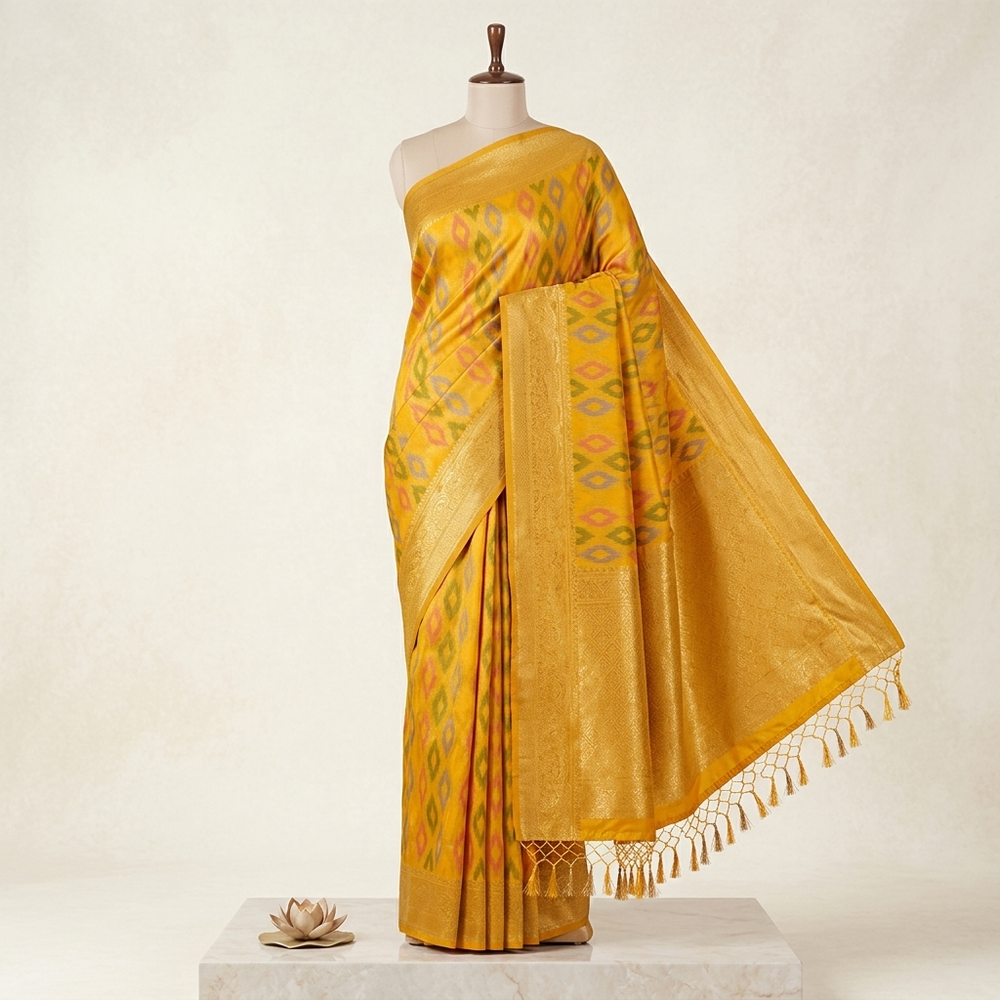
Yellow is cheerful, and it’s one of the safest colours for daytime pujas.
- Saree: A yellow cotton saree with block prints or a light embroidered border
- Suit: A yellow palazzo suit, comfortable enough for a long day of visitors
- Yellow with a pink or green dupatta is a classic pairing that never fails
Day 6: Green for Maa Katyayani
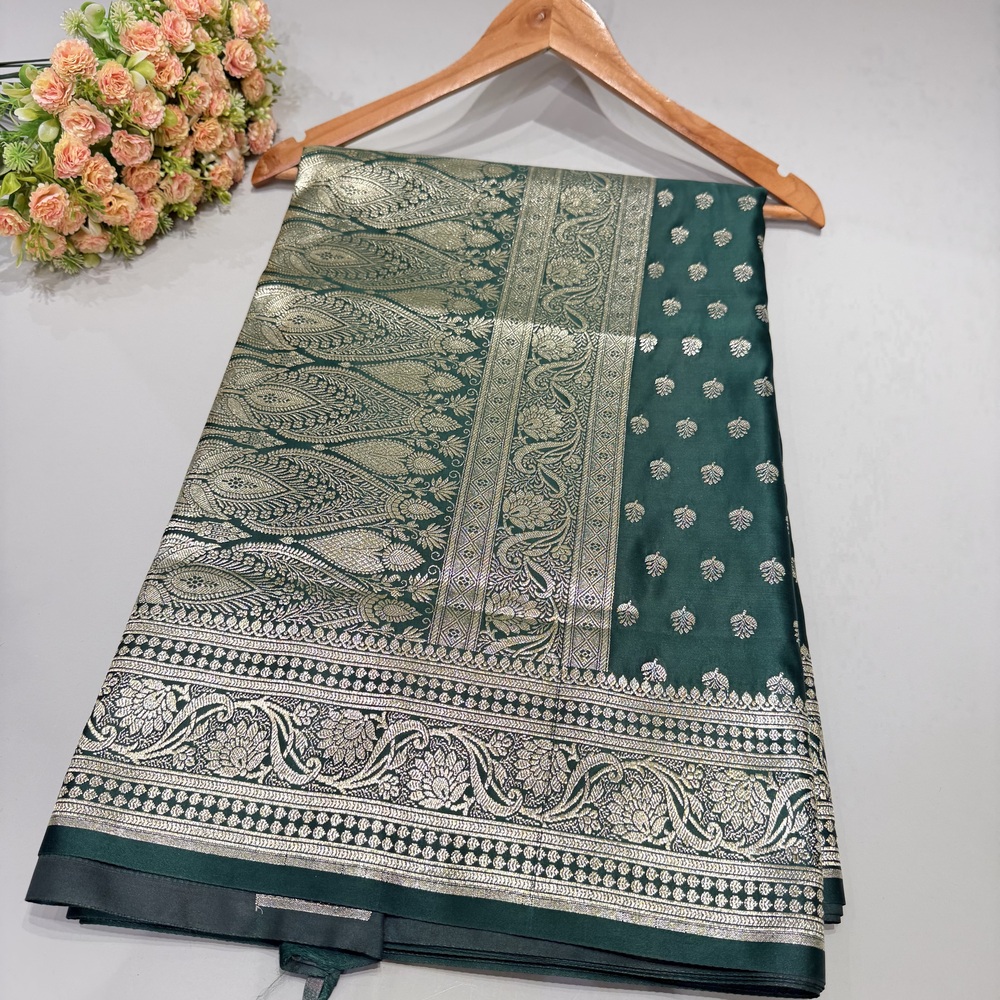
A Friday means many of us are heading to work first and puja after.
- Saree: A bottle green silk or Banarasi saree for the evening
- Suit: A mint or sage green cotton suit that works from office to aarti without a change
- Gold jewellery lifts every shade of green
Day 7: Grey for Maa Kalaratri
Grey is the day most people dread, because it can look dull if styled carelessly. It doesn’t have to.
- Saree: A grey organza saree with a contrast blouse in coral, pink or maroon
- Suit: A grey georgette suit with silver embroidery and a brighter dupatta
- Oxidised silver jewellery suits grey far better than gold does
Day 8: Purple for Maa Mahagauri
Ashtami falls here for many families, so this outfit may double as your Kanya Pujan look (more on that below).
- Saree: A lavender or aubergine silk saree with a delicate border
- Suit: A deep purple Anarkali or straight-cut suit
- Choose a fabric that won’t fuss while you’re up and down serving guests
Day 9: Peacock Green for Maa Siddhidatri
The last day deserves your best outfit, and peacock green, that rich blue-green shade, is made for it.
- Saree: A peacock green Banarasi or silk saree with gold zari
- Suit: A peacock green sharara or Anarkali suit for the Navami evening
- Screens can misjudge this shade, so it helps to see it in person before buying
Kanya Pujan Day Outfit Ideas
Kanya Pujan is held on Ashtami (18 October) in some homes and Navami (19 October) in others, depending on family tradition. Whichever day you follow, you’ll spend the morning cooking, washing feet, serving food and bending down repeatedly. This is not the day for a heavy saree or a dupatta that trails.
What works best:
- A straight-cut cotton or chanderi suit. Easy to sit in, easy to move in, and forgiving if the prasad plate tilts.
- A palazzo suit. Comfortable for the whole morning, with no pleats to fix mid-ritual.
- A cotton silk saree with a pre-pinned drape. You keep the traditional look without constantly adjusting the pallu.
For colour, go with the day’s shade (purple or peacock green), or choose red or yellow, which many families favour for the occasion. Our suit styles guide has more on which silhouettes suit which occasions.
A small safety point: with diyas and agarbatti around, pin your dupatta neatly and avoid very loose, flowing sleeves.
Dussehra: What to Wear on Vijayadashami
Dussehra falls on Tuesday, 20 October. Most Navratri colour charts stop at Day 9, so there’s no fixed colour for Vijayadashami. That leaves you free to choose, and red, saffron, gold or a favourite shade all feel right for a day that marks the victory of good over evil.
- For a family lunch or puja at home: A Banarasi or organza saree, or a silk suit with zari work
- For the evening (Ramlila, melas, Ravan Dahan): An Anarkali or Pakistani suit that is easy to walk in, with a dupatta you can secure
- If you’re wearing the same outfit twice: Change the dupatta and jewellery, and nobody will notice
Accessorizing Tips
The right accessories make a nine-day wardrobe stretch much further than you’d expect.
- Match the metal to the colour. Gold suits red, yellow, green and peacock green. Silver and oxidised pieces suit grey, white and royal blue.
- Keep fasting days simple. Small jhumkas and a light bangle set are enough when you’re on your feet all day.
- Use dupattas to reuse suits. One plain suit with three different dupattas gives you three looks.
- Choose footwear for standing. Juttis or flat sandals for daytime pujas, block heels only for evenings.
- Add a gajra or fresh flowers. Cheap, easy, and it instantly makes an ordinary outfit look festive.
- Carry a small potli. Enough space for your phone, a handkerchief and a few essentials, with both hands free for the thali.
Shop the Collection
Whether you’re planning nine separate outfits or just three or four that you’ll style differently, it helps to see the fabric and shade before you buy. If you’re in or around Faridabad, you can try outfits in person at the Ohrisons Faridabad store, which is especially useful for shades like peacock green, royal blue and grey that can look different on a phone screen.
Some quick planning advice:
- Pick your Day 1, Day 8 and Day 9 outfits first, since those are the days most families dress up
- If you’re buying unstitched suits, book your tailor early because festive weeks fill up fast
- Look for pieces that can be worn again for Diwali and wedding functions, so your Navratri outfits keep earning their place
FAQs
1. Which colour should I wear on the first day of Navratri 2026?
2. What are all nine Navratri 2026 colours in order?
3. Is it compulsory to wear the colour of the day during Navratri?
4. What should I wear for Kanya Pujan?
5. What colour should I wear on Dussehra 2026?